

8-9 Months
A private security service company managing 1,000+ employees across multiple locations relied on separate systems for employee management, attendance, payroll, and reporting, resulting in inefficient and fragmented workflows.
I designed a custom ERP platform that brought these processes into a single system, making workforce management more efficient and creating a scalable solution for future growth.
The client with over 1,000 employees was managing workforce operations through multiple disconnected systems.
Key challenges included:
Employee management, attendance tracking, payroll, and reporting were handled in separate applications, all connected through a shared MS Access database.
Payroll calculations required manual processing and cross-verification.
Attendance and shift scheduling were difficult to track across multiple sites.
Report generation was time-consuming and prone to errors.
Maintaining and updating the system was costly due to dependencies on a shared database structure.
Operational teams lacked a centralized view of workforce activities.
Without a centralized view of workforce operations, operational teams struggled to manage day-to-day activities efficiently, leading to increased administrative effort and reduced visibility across the organization.

After the Initial product (ERP) delivery, our team looked beyond this one client to ask whether the same problems existed elsewhere.
The research revealed that many agencies (multiple local security service providers) still relied heavily on:
Excel spreadsheets
Manual attendance tracking
Paper-based processes
Disconnected payroll workflows
Repetitive administrative tasks
In other words, these findings highlighted a broader problem beyond a single client's needs. That reframed the whole project.
Key Insights:
Fragmented systems created real friction; teams switched between multiple tools to complete a single workflow.
Payroll processing was highly manual; Manual calculations increased processing time and introduced opportunities for human error.
Workforce visibility was limited; Managers struggled to obtain a consolidated view of attendance, scheduling, employee records, and payroll status.
Existing solutions did not scale well, many security agencies lacked purpose-built workforce management software customized to their operational structure.
Understanding Business Workflows:
I worked closely with stakeholders to understand:
Employee onboarding processes
Attendance management workflows
Shift scheduling requirements
Payroll processing cycles
Reporting needs
Client management operations
Information Architecture:
As the platform brought together multiple business functions, creating a clear and scalable information architecture became essential. I designed navigation that aligned with operational workflows, making it easier for teams to find information and complete tasks efficiently.
Workflow Design:
Key workflows were mapped and optimized for:
Employee management
Client management
Attendance tracking
Shift scheduling/Assign employees
Payroll processing
Reporting
Invoice management (Designed Later)
Interface Design:
The UI was designed to prioritize speed, clarity, and ease of use, ensuring that users could efficiently manage their day-to-day operations without being overwhelmed by the system's complexity.
Special Attention was given to:
Data-heavy screens
Form optimization (Accordion style)
Table management
Workflow visibility
Action prioritization

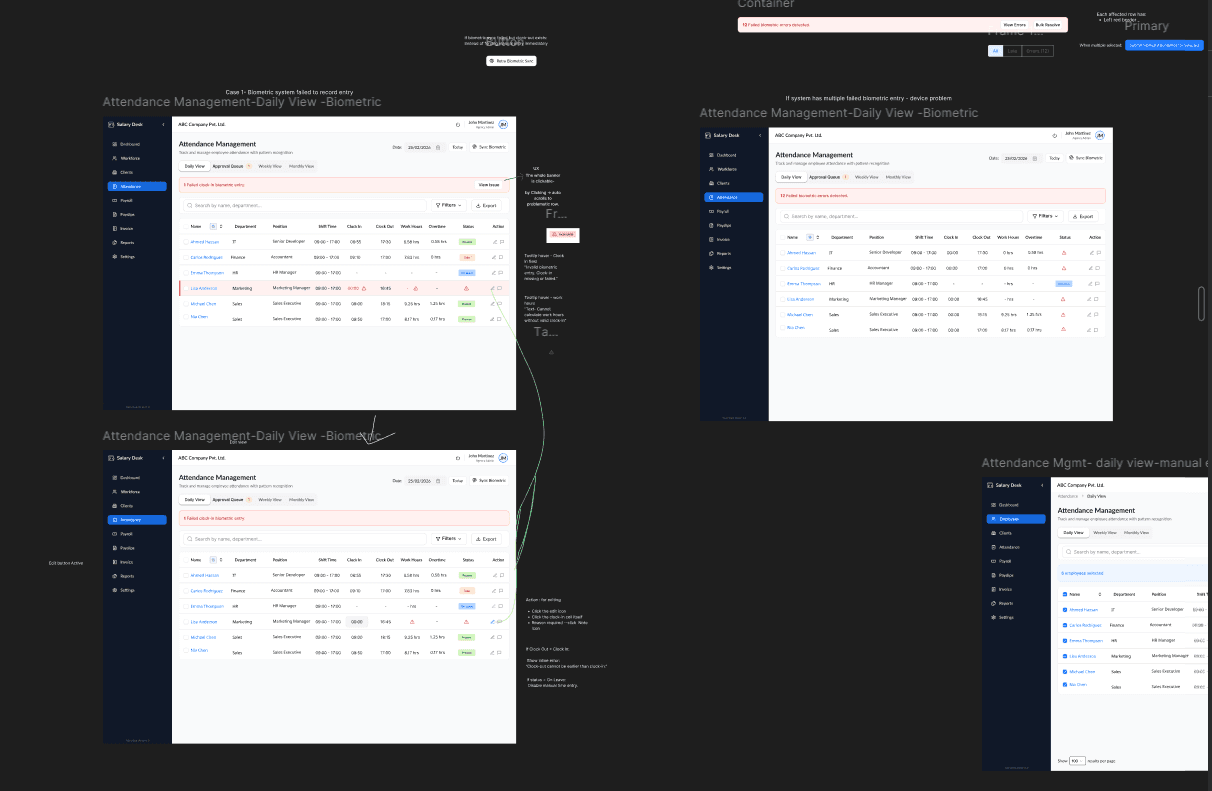
The solution was a custom ERP platform (Paytrack) that consolidated multiple business functions into a unified experience.
Core Modules Included:
Employee Management - Centralized employee records and workforce information.
Attendance & Shift Scheduling - Tools for managing workforce allocation across multiple sites and shifts.
Payroll Management - Structured workflows that simplified salary processing and reduced manual effort.
Reporting - Improved access to operational and financial reports.
Client & Invoice Management - For managing client information and billing-related activities.
Product Evolution:
One of the most valuable outcomes of the project was discovering that the challenges faced by the client were common across the security services industry.
Research conducted with other agencies revealed similar operational pain points, leading to the redesign and evolution of the platform into a more scalable solution.
Rather than remaining a client-specific tool, the product began evolving toward a broader workforce management platform capable of serving multiple organizations with similar operational requirements.
The platform is currently in active development while being partially adopted by the client.


Business Impact:
Unified previously disconnected operational workflows.
Reduced reliance on multiple systems.
Established a foundation for scalable workforce management processes.
Informed future product strategy through market validation and user research.
Design Impact:
Improved workflow clarity across complex business operations.
Simplified access to workforce and payroll information.
Established a scalable information architecture for future product growth.
This project strengthened my understanding of enterprise software, operational workflows, and product discovery.
Beyond designing interfaces, I learned the importance of understanding how businesses operate, validating assumptions through research, and designing systems that can evolve beyond the needs of a single client.
One of the most valuable lessons was recognizing that a client-specific problem could represent a broader market opportunity, and having the judgment to revisit my own earlier decisions once that became clear.
Designing for one company's workflow and designing for an industry's look similar on the surface, but they require different IA decisions underneath.
The experience reinforced the importance of balancing user needs, business goals, and long-term product strategy when designing complex B2B platforms.